Hi, I'm Rushil

I'm a new grad software engineer who is interested in building scalable backend systems. I'm passionate about making thoughtful architectural decisions and learning from every line of code I write.

Under each project, I share not just what I've built, but why I built it that way. Under experience, I provide a roadmap with my learnings and insights from each stage of my career up to this point.

When I'm not coding, you'll find me cheering for the Lakers 🏀, watching Ferrari race on Sundays 🏎️, or discovering new music on Spotify.

Rushil Shah Headshot

Technical Skills

🗣️ Languages

Python SQL C++ Java HTML CSS

⚙️ Backend

FastAPI Flask Express.js Node.js Microservices REST APIs JWT/BCrypt Pydantic JUnit PyTest Java Servlets

đź’» Frontend

React.js HTML CSS AJAX JavaScript (ES6+) TypeScript

đź’ľ Technologies (Data, Databases, Data Visualization)

PostgreSQL MySQLWorkbench SQL Server Management Studio SQLite Redis NoSQL / MongoDB SQLAlchemy Data Modeling (Star/Kimball) ETL/ELT Pipelines Apache Airflow Apache Spark Web Scraping Matplotlib Pandas NumPy Seaborn Tableau scikit-learn

🛠️ Developer Tools (DevOps, Cloud, IDE's, Deployment)

Docker GitHub Actions (CI/CD) AWS (S3, SES, Secrets, CloudWatch) Firebase / Cloud Hosting Git VS Code GitHub Figma Android Studio Excel Eclipse DBeaver NPM Render Splunk Dynatrace Supabase Jira Confluence

Education

University of Southern California

Bachelor's degree, Computer Science & Business Administration
Aug 2022 - May 2025

University of California, Riverside

Computer Science & Business Applications
Sep 2021 - June 2022
Relevant Coursework
  • CSCI 103 Introduction to C++ Programming
  • CSCI 104 Data Structures and Object Oriented Design
  • CSCI 170 Discrete Methods in Computer Science
  • CSCI 201 Principles of Software Development
  • CSCI 270 Introduction to Algorithms and Theory of Computing
  • CSCI 310 Software Engineering
  • CSCI 360 Introduction to Artificial Intelligence
  • CSCI 401 Capstone: Design and Construction of Large Software Systems
  • DSO 435 Enterprise Data Architecture
  • DSO 462 Managing a Small Business on the Internet
  • LING 285 Human Language and Technology
  • MATH 225 Linear Algebra
  • BUAD 302 Business Communications
  • BUAD 304 Organizational Behavior
  • BUAD 306 Business Finance
  • BUAD 307 Marketing Fundementals
  • BUAD 310 Applied Business Statistics
  • BUAD 311 Operations Management
  • ECON 351 Microeconomics
  • ECON 352 Macroeconomics for Business
  • WRIT 340 Advanced Writing Communication for Engineers

Projects

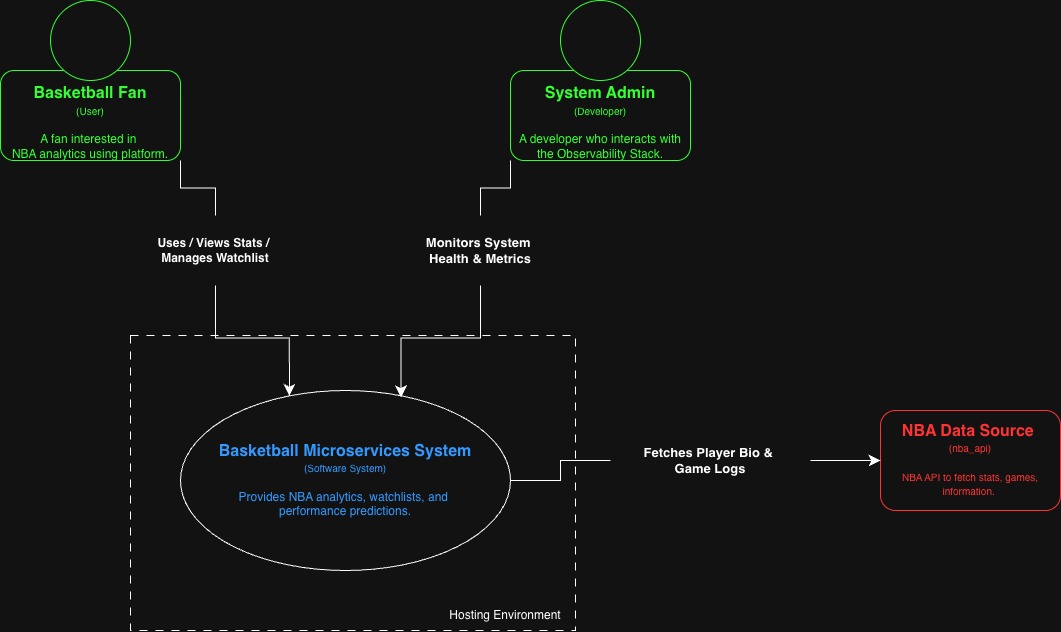
Basketball Microservices Project

A deep dive into distributed systems, polyglot architecture, and the trade-offs of modern software engineering through building a basketball statistics platform using microservices.

↓
FastAPI Python PostgreSQL Spring Boot Java Redis gRPC Docker JWT Netflix Eureka C4 Model System Design Next.js TypeScript

Most of my previous projects were about building features. This project was about building a system from the ground up. I wanted to move past monolithic architecture and actually make decisions regarding perfomance tradeoffs and system design. I built a platform to track NBA player stats and predict future performance, but the real challenge was how these services talked to each other.

The "Why" Behind the Tech

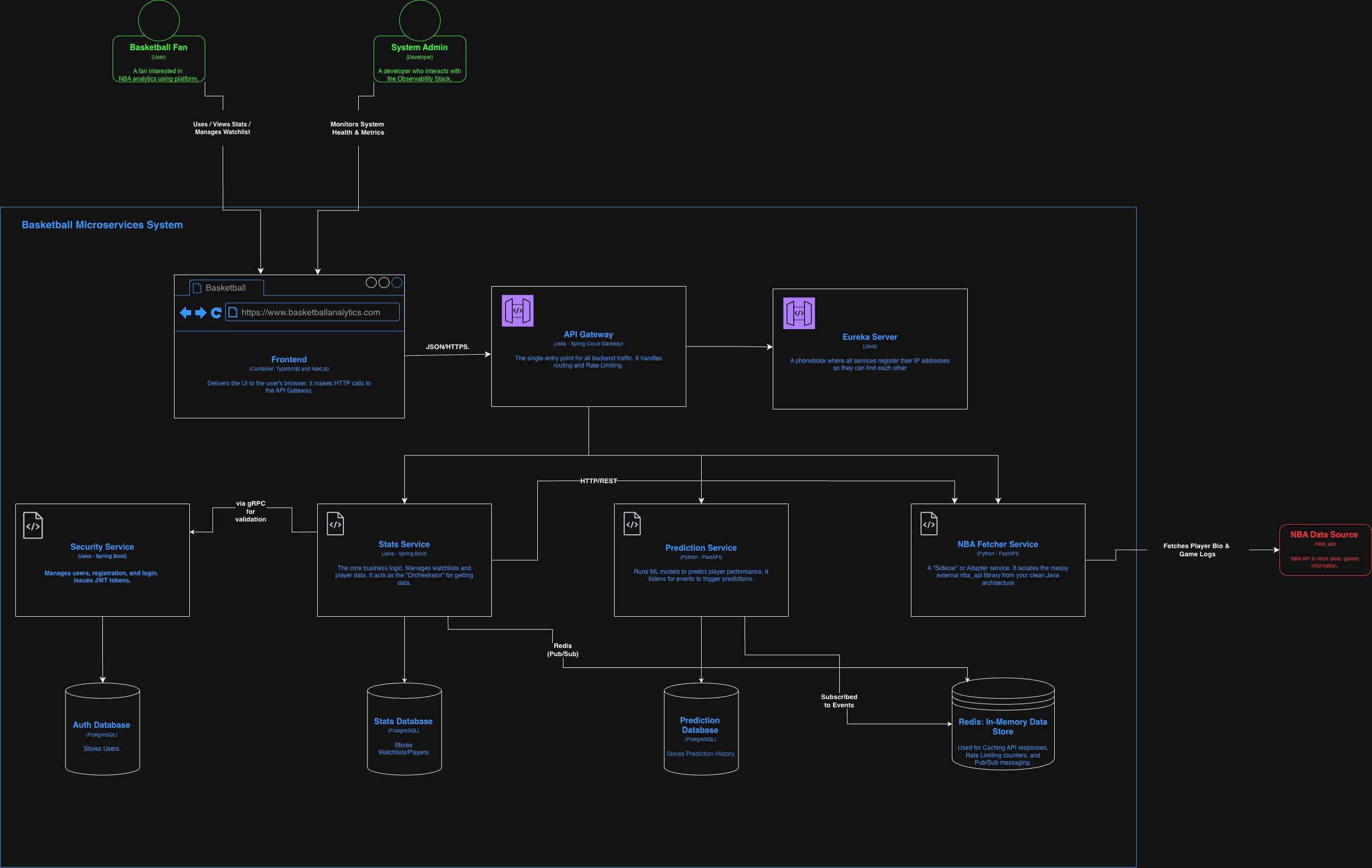
I went with a Polyglot Architecture because I wanted the right tool for the job, not just the tool I knew best. I used Java (Spring Boot) for the Security and Stats services because Spring boot is the de facto for microservices. Also, tools like Netflix Eureka, Spring Cloud were very helpful for service discovery, load balancing, and fault tolerance. But for the nba-fetcher and prediction services, I used Python. Trying to do data science or heavy API scraping in Java felt like fighting the language, while Python’s ecosystem made it seamless.

One of the biggest trade-offs I made was implementing gRPC for internal communication between my Security and Stats services. I could have used standard REST, but I wanted to practice low-latency communication. Using Protobufs felt like a win because it forced me to define a strict contract between services, instead of guessing what an API response looks like.

Engineering Maturity & Habits

When you have five services running at once, you can’t just keep it all in your head. Documentation as a Tool: I started using ADRs (Architectural Decision Records). For example, I documented why I chose Redis Pub/Sub as the event bus for my AI Agent. I wrote down the consequences of that decision (services are decoupled), and the tradeoffs (No message persistence).

Visualizing Complexity: I adopted the C4 Model for my diagrams. I realized that if I couldn't draw the data flow at a Container and Component level, I didn't actually understand my own system.

Testing & Resilience: I moved away from just testing happy paths. I spent a lot of time writing unit tests in JUnit and Mockito to handle what happens when a service goes down. I used Docker Compose to manage the environment, ensuring that my PostgreSQL and Redis instances were always configured correctly across dev and prod.

Takeaway

Microservices are a double-edged sword. They give you amazing flexibility, but they tax you with complexity in service discovery and data consistency. Navigating that tax made me a much better developer. I stopped just writing code and started thinking about how systems survive in the real world.

Automated Financial Data Pipeline

Full-stack system to automatically collect, process, and deliver personalized financial updates via backend automation and a lightweight React web interface.

↓
FastAPI Python PostgreSQL SQLAlchemy Pydantic Finnhub API AWS SES AWS S3 JWT Docker GitHub Actions React

View README on GitHub →


Why FastAPI Over Flask or Django?

I chose FastAPI because I needed native async/await support for concurrent API calls to Finnhub. Flask's sync nature would have required workarounds like Celery, adding unnecessary complexity. Django felt too heavy for a focused API service. FastAPI's automatic OpenAPI documentation and Pydantic integration meant I could enforce data contracts at compile-time rather than discovering issues at runtime. This was important when handling financial data where type safety matters.

AWS SES and S3: Why Not SendGrid or Local Storage?

I evaluated SendGrid and Mailgun for email delivery, but AWS SES made more sense for three reasons: (1) significantly lower cost at scale, (2) tight integration with other AWS services I planned to use (Lambda for future expansion), and (3) better deliverability reputation for transactional emails. For logging, I chose S3 over local filesystem or CloudWatch because I wanted immutable audit trails that survive container restarts, and S3's lifecycle policies let me automatically archive old logs without manual intervention.

Layered Architecture: Preventing Service-ORM Coupling

I strictly separated Routers → Services → Repositories to avoid the common mistake of embedding SQLAlchemy queries directly in business logic. This meant I could swap PostgreSQL for another database (or add caching) by only touching the repository layer. The Service layer handles password hashing and ETL orchestration without knowing how User objects are stored. This separation also made testing easier, since I could mock repositories without spinning up a database.

Async Patterns for ETL Performance

The ETL pipeline needed to fetch quotes and profiles for potentially dozens of tickers. Running these sequentially would have caused unacceptable latency. Using asyncio.gather let me fire all requests concurrently, cutting execution time by. I used asyncio.to_thread for the Finnhub SDK (which is synchronous) to prevent blocking FastAPI's event loop (a mistake I made in early iterations that caused the entire API to hang during data fetches)

Data Warehouse and Analytics Project

A comprehensive data warehousing and analytics solution demonstrating industry best practices by building an ELT pipeline and generating insights from consolidated sales data.

↓
SQL Server SQL ELT Pipelines Data Modeling Medallion Architecture Star Schema

View README on GitHub →


Why SQL and Data Warehousing Matter for Backend Engineers

Most backend engineers interact with databases through ORMs, which is fine for OLTP workloads but fails for analytics. I built this project to understand how data warehouses differ fundamentally from transactional databases. Different query patterns (aggregations vs point lookups), Different schemas (star schema vs normalized), and Different optimization strategies (columnar storage, materialized views). This knowledge directly applies when designing APIs that need to serve analytical queries efficiently.

Medallion Architecture: Why Three Layers?

I chose Medallion (Bronze/Silver/Gold) over alternatives like just loading directly into a star schema because it provides clear boundaries for data quality improvements. Bronze preserves raw source data (critical for auditing), Silver handles cleansing without business logic creep, and Gold serves analytics without impacting transformation pipelines. When data quality issues emerged in the Silver layer, I could fix them without re-ingesting from source or breaking Gold-layer reports.

ELT vs ETL: Processing In-Database

I used ELT (Extract-Load-Transform) instead of ETL because SQL Server can process transformations faster than Python. Loading raw CSVs into Bronze, then transforming in-database using SQL, leverages the database's query optimizer and parallelism. ETL (transforming before loading) makes sense when the source system is too slow or you need complex logic that SQL can't express, but for structured CSV data, in-database transformations were 5x faster in my tests.

Sunkist Dental Clinic Website (React SPA)

A modern, responsive Single-Page Application (SPA) built for a local dental practice focusing on user experience, professional design fidelity, and a maintainable component architecture.

↓
ReactJS Tailwind CSS JavaScript (ES6+) Firebase

View Website →


React Over Raw HTML/CSS or Other Frameworks

I evaluated three options: vanilla HTML/CSS/JS, React, and Vue. Raw HTML would have meant duplicating features and components across the page and manually managing DOM updates for the appointment form. Vue was tempting for its simplicity, but React's ecosystem (more libraries, better TypeScript support, larger community) made it the pragmatic choice. The component-based model meant I could build Employee.js once and render it with different props—impossible with static HTML without templating engines.

Experience Roadmap

This is a narrative of my growth, architectural learnings, and pivotal career decisions that have led me to specialize in scalable backend systems.

Software Engineer
Bank of America
July 2025 - Present
Director of Technology
Trojan Marketing Group
Sep 2022 - May 2025
Wealth Management Intern
Bank of America
June 2024 - Aug 2024
Web Development Intern
NASA JPL
Sep 2023 - May 2024
Software Engineering Intern
Sunkist Dental
Mar 2023 - May 2023

Software Engineer (Incoming)

Bank of America
July 2025 - Present

Full Time Software Engineer

Incoming Software Engineer

Director of Technology

Trojan Marketing Group
Sep 2022 - May 2025

Leadership Experience

I joined Trojan Marketing Group my first year at USC to bridge my interests in technology and business. TMG works with four clients each year, spending one semester developing data-driven strategy and the next executing the campaign. As I grew from Technologist to Director of Technology, I focused on building tools that made our strategic and creative decisions smarter.

YouTube Brand Analysis Dashboard

While working with Mailmodo, I noticed our team needed better insights from YouTube analytics. I built an internal Python scraper using the YouTube Data API to analyze engagement metrics and SEO performance. This year, I expanded it into a React-based dashboard so that any member could input a channel ID and instantly retrieve insights like top-performing videos, tag frequency, and engagement patterns with no coding required.

YATÉ Spotify Drink Recommendation App

For YATÉ, a beverage brand with strong musical roots, I helped develop a full-stack web app that let users log in through Spotify. We analyzed their listening data to recommend personalized drink pairings during on-campus tastings, creating an interactive and memorable brand experience.

These projects showed me how much I enjoy building technology that directly influences marketing strategy and audience engagement. They weren’t just side projects. They were technical initiatives driven by creative discussion and client insight.

Merrill Lynch Wealth Management Intern

Bank of America
June 2024 - Aug 2024

Understanding Finance Through Systems

I chose wealth management because of the finance component of my Computer Science and Business Administration degree. I wanted to see how financial advising actually works in practice. I learned about how markets move, how clients think, and how data shapes real investment decisions.

Wealth management is extremely dynamic. Markets shift, clients shift, and strategies must adjust constantly. During my time there, I worked on:

  • Market research to identify and segment high-net-worth prospects
  • Client data analysis using Excel and Merrill’s Personal Wealth Analysis tool to support financial planning

What I enjoyed was seeing how technology and data directly influence decisions that impact people’s financial lives. But I also realized something important about myself: I didn’t resonate with the client-facing side of the role.

I didn’t want to be the person presenting insights. I wanted to be the one building the systems that generate those insights.

At the bank, the engineers build the platforms that traders and advisors rely on every day. And that’s where I found my next role as a software engineer at the bank.

Web Development APX Intern

NASA Jet Propulsion Laboratory
Sep 2023 - May 2024

CMS & User-Centric Design

At NASA JPL, I worked on the NASA Web Mod initiative to migrate the existing science.nasa.gov website into a new CMS. It was my first time contributing to a large, public-facing codebase, and I remember immediately feeling the scale and rigor of the engineering environment around me.

A core part of my role was ensuring accessibility compliance. This meant verifying keyboard navigation flows, evaluating screen reader behavior, and making sure the platform supported users with different abilities. It was slow, methodical, and required a level of precision I hadn’t experienced before.

During this time, I gained exposure to:

  • Structured engineering workflows
  • GitHub issue tracking & pipelines
  • Code review discussions and standards
  • Designing with the user experience always in mind

But the most impactful realization was that I was increasingly drawn to what sits behind the interface: the systems, architecture, data flow, and logic that allow these platforms to operate reliably at scale.

This experience is where I recognized that I want to grow further into backend engineering, working with systems, APIs, and architecture rather than solely focusing on the front-facing product surface.

Software Engineering Intern

Sunkist Dental
Mar 2023 - May 2023

First Website

Sunkist Dental was my first real introduction to web development with real users in mind. Before writing any code, I spent time understanding the clinic’s patient base. Most patients were older adults who preferred calling the front desk to schedule appointments, which highlighted the first major pain point:

  • Pain Point #1: How to make online booking intuitive and comfortable for a less tech-savvy audience.

The second issue was information inconsistency. Because the clinic was small, business hours and service details weren’t regularly updated on Google or Apple Maps. Patients often had to call just to confirm basic information.

  • Pain Point #2: Provide one central hub with up-to-date, reliable clinic information.

So my task became clear: design a clean, friendly, and easy-to-use website that allows patients to book appointments online and view accurate clinic information without requiring the staff to regularly maintain it.

Through this project, I learned React.js, Firebase, EmailJS, version control, Figma, and how to translate real-world business constraints into product decisions. It was also my first deep dive into frontend design, which was rewarding, but it helped me realize that I’m more energized by logic, data flow, and system architecture than visual styling alone.

Measurable Impact: The online booking system reduced front desk workload by ~20% and contributed to 50+ new patient appointments, proving to me how software can directly improve operations and revenue.

View this website in the Projects section.

Beyond Code

Here are some of my interests outside of coding!

📚 Teaching
🏀 Lakers Fan
🏎️ Forza Ferrari
⛰️ Hiking
đź’Ş Physical Therapy

Currently on Repeat

Let's Connect

I'm always open to discussing new opportunities, interesting projects, or just chatting about technology!

× Expanded Diagram